Audio cable types
Balanced and Unbalanced cables
Tip, Ring, Slave
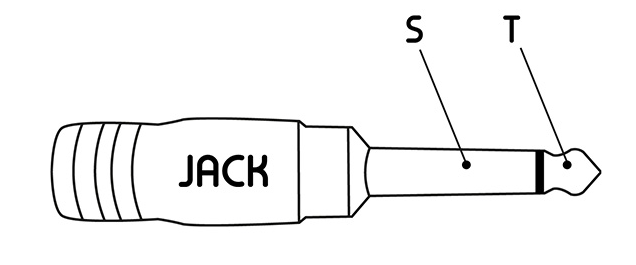
- Unbalanced cable (2 wires) -
TStype, tip for the signal and slave for the ground - Balanced cable (3 wires) -
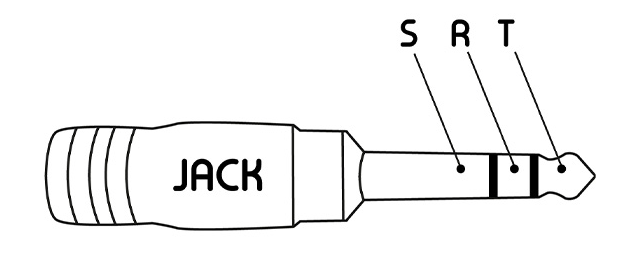
TRStype, tip for the positive polarity signal, ring for the negative polarity signal, and slave for the ground
audio jack
The unbalanced cable is usually seen with 6.35mm (1/4 inch) jack and RCA jack
The balanced cable is usually seen with XLR jack (3-pin) or 6.35mm (1/4 inch) jack
- Signal runs on an unbalanced cable is prone to distortion caused by noises with > 10 feet distance.
- The different polarity signals are added to a balanced cable through a supported audio equipment. The negative polarity signal will flip to match the positive polarity signal when reach at the other end (supported audio equipment).
zero out noise
The noise generated on a balanced cable will be in the same waveform on both conductors/wires carrying +/- polarity signals. At the receiving end, when the negative polarity signal flipped, the noise will be zeroed out. It's called Common-mode rejection
Mono and Stereo
- Unbalanced cable and balanced cable have nothing to do with mono or stereo signals. DON'T be confused with it
- An unbalanced cable can carry either mono channel signal or stereo channel signal, same as a balanced cable.
- A balanced cable, however, can either carry a mono channel signal with the polarized feature (balanced) mentioned above (
Tfor hot + signal andRfor cold - signal), or use the two conductors/wires to carry left and right channels of a stereo signal in an unbalanced fashion.
more `r`
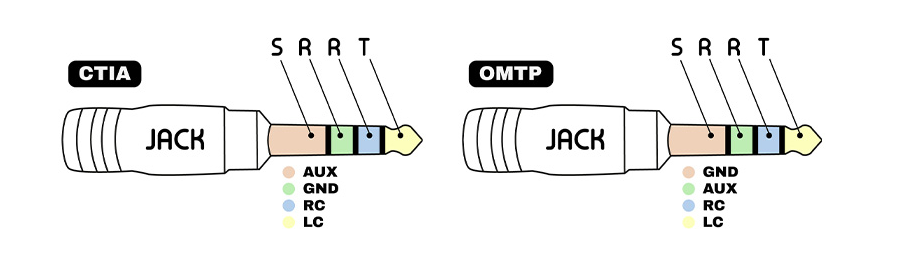
Besides TRS type, there are TRRS and TRRRS types
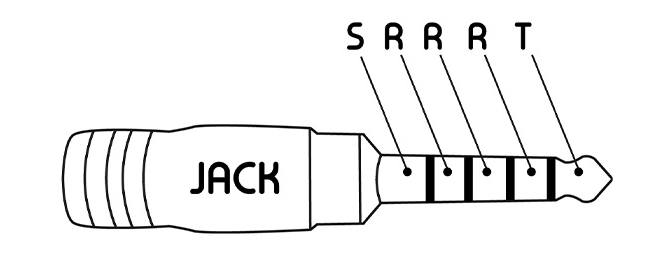
TRRS: like TRS, the extra conductor/wire can be used as an added function such as microphone or video signals (AUX). There is unified standard for this case, compatibility check is needed. The CITA (wireless association) standard is commonly used today.TRRRS: for transmitting balanced stereo signals- Tip: left channel (+)
- Ring: left channel (-)
- Ring: right channel (+)
- Ring: right channel (-)
- Slave: ground
Illustrations
-
TS
-
TRS
-
TRRS
-
TRRRS
Balanced vs. Unbalanced
- It's recommended to use balanced cables to be able to eliminated noises if possible
- However, based on the applications and cost considerations, an unbalanced cable can be a fit if:
- The distance (cable length) is <= 10 feet
- An unbalanced cable is much cheaper than a balanced cable
- A balanced signals need a supported audio equipment (more complicated and more expensive)
- An electric guitar, for example, can produce much stronger signals than noises, the distortion won't be noticeable even using an unbalanced cable.